Baldwin of Luxembourg
Power was built with more than walls
An archbishop, a territorial ruler and a political negotiator. His castle stories move between siege works, captivity and agreements that changed who held power.
- Life
- c. 1285–1354
- Known for
- Archbishop & territorial ruler
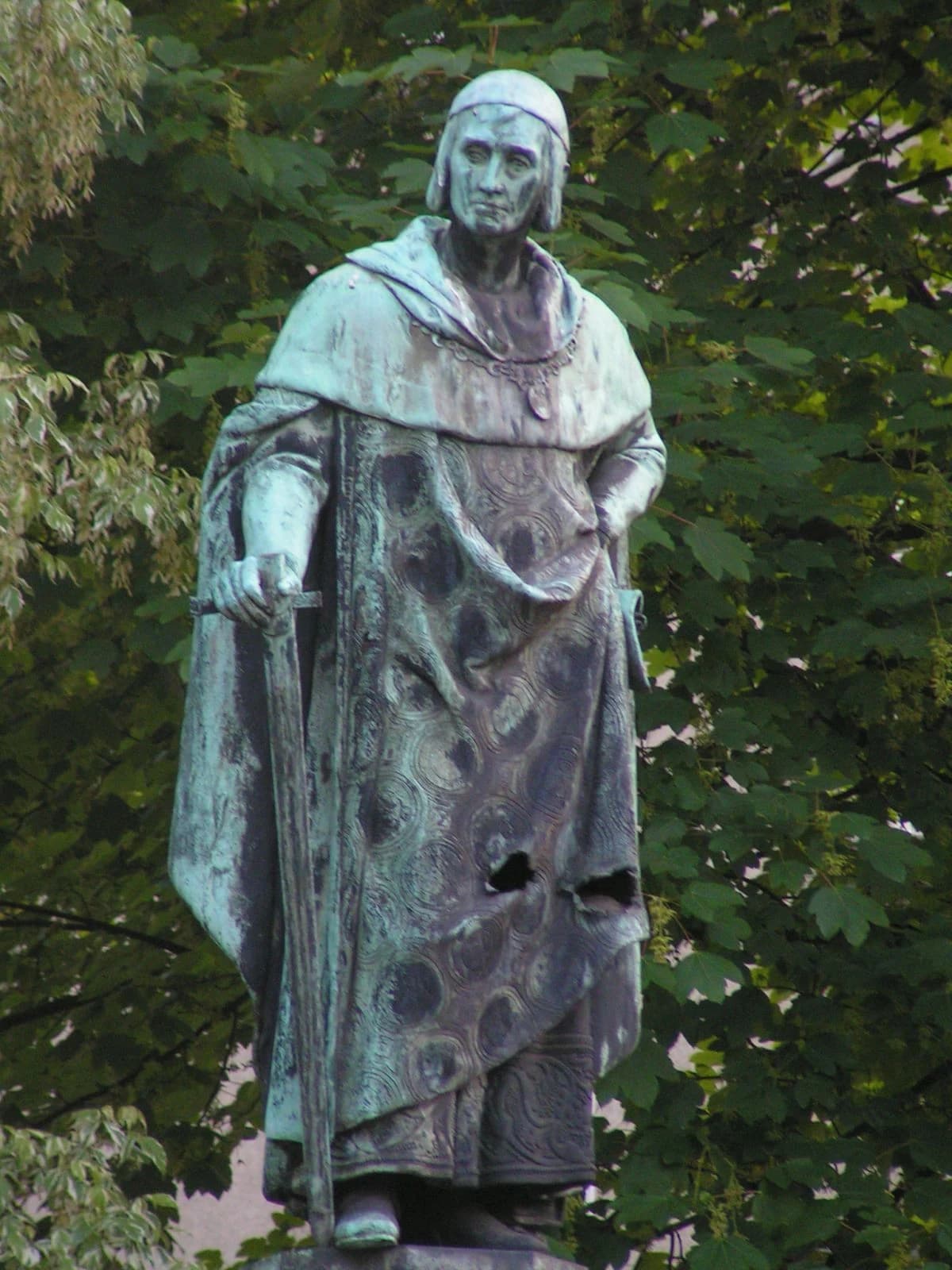
Above the valley near Burg Eltz stands the ruin of a much smaller fortress. It was built to put pressure on its neighbour. To understand the larger castle’s story, it helps to look across the valley—and to the archbishop who wanted more than a military victory.
Early 14th-century Empire
A life in context
Baldwin belonged to the House of Luxembourg and was the brother of Emperor Henry VII. Known both as Baldwin of Luxembourg and Baldwin of Trier, he combined church office with the government of a secular territory.
His selection in late 1307 and appointment and consecration in 1308 were separate stages. The lands he governed were not a neatly bounded state: rights overlapped, and the extent of authority could be contested. A castle’s place in that network mattered as much as its walls.
B1B2Why fight the lord of a castle?
The Eltz Feud concerned disputed authority and obligations, not simply the defeat of unruly knights. The families of Eltz and their allies resisted claims that would bind them more closely to the Archbishop of Trier.
Baldwin established the siege fortress Baldeneltz, also known as Neu-Eltz and commonly called Trutzeltz today. Its position made sustained pressure possible. The settlements and arrangements of the 1330s changed relationships of service and dependence: a castle could remain standing while its political freedom narrowed.
B3B4The archbishop becomes a captive
In 1328, the forces of Countess Loretta of Sponheim captured Baldwin during a journey on the Moselle and held him at Starkenburg. The dispute involved competing territorial rights. It was more than a colourful kidnapping for money.
A scholarly summary of a settlement dated 7 July 1328 records his agreement with the countess who had captured him. The episode reveals a female regent acting to defend her family’s interests—and a powerful church prince forced to negotiate. The exact capture tactics, duration and ransom should not be reconstructed from conflicting later accounts.
B5B6B7Agreements could preserve the result of a siege
In disputes connected with Schmidtburg, settlements addressed rights, fiefs and the use of castles. An opening right could allow a lord to use another person’s stronghold under agreed conditions; it did not automatically mean complete ownership.
This makes a castle more than a military object. Who could enter, inherit, maintain or dispose of it might determine power long after the fighting stopped. Baldwin’s systematic preservation of documents helped turn claims and settlements into durable instruments of government.
B3One riverside site, more than one builder
Around 1330, Baldwin promoted fortification at Eltville amid his rivalry with Heinrich von Virneburg over Mainz. The residential tower of the surviving castle belongs to a later phase, built under Heinrich around 1340.
This is a reminder that buildings can cross political divisions. Baldwin belongs in Eltville’s story, but not every surviving wall can be credited to him. Even an impressive castle is the work of successive decisions, including those of rivals.
B8CHRONOLOGY
Turning points
Born into the House of Luxembourg.
Selection, appointment and consecration as Archbishop of Trier.
Captured by Loretta of Sponheim’s forces; a settlement is recorded on 7 July.
Administrator of Mainz.
Fortification at Eltville.
The Eltz conflict and its settlements.
Dies in Trier on 21 January.
PLACES & CONNECTIONS
Places in this story
Each connection has its own story. Building, finding refuge and facing a siege are very different relationships.
HISTORY & MEMORY
History, memory & uncertainty
Different names, one person
Balduin von Luxemburg and Balduin von Trier refer to the same archbishop. His ecclesiastical diocese and secular territory were not identical.
A feud with several ending dates
Accounts use different dates for surrender, settlements and later arrangements. This story follows specialist research in describing the conflict as 1331–1336/37.
Capture without invented detail
The captivity and settlement are supported. Precise ransom figures and dramatic river tactics are not treated as established facts here.
Reading a ruler’s legacy
Administrative achievement and the loss of other people’s autonomy can coexist. The preservation of order should not be mistaken for a complete moral assessment of his rule.
Sources & further reading
Based on heritage institutions, museums, academic research and historical documents. Sources are attached to the relevant sections.
- B1LVR / Johannes Mötsch|Balduin von Luxemburg
- B2Germania Sacra|Balduin von Luxemburg(GSN 062-00055-001)
- B3LVR / Julia Eulenstein|Die Fehdepolitik des Trierer Kurfürsten Balduin von Luxemburg
- B4LVR|Burgen an der Mosel
- B5Regesten der Mainzer Erzbischöfe|Vogt Nr. 2936
- B6Gemeinde Starkenburg|Geschichte
- B7Verbandsgemeinde Baumholder|Loretta von Sponheim
- B8Landesamt für Denkmalpflege Hessen|Kurfürstliche Burg Eltville
Editorial review · 27 October 2026
CONTINUE READING