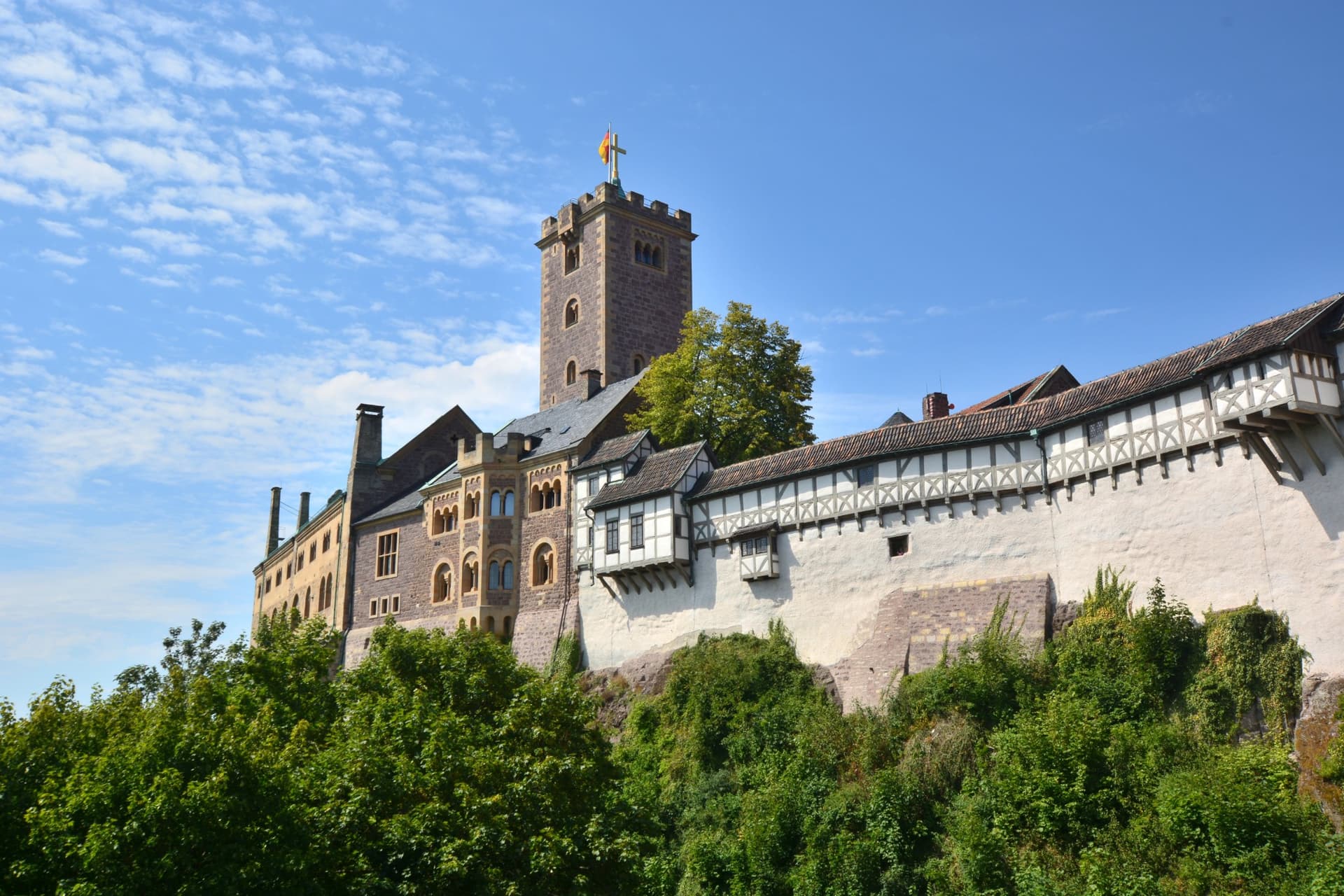
 Court life & later remembrance
Wartburg Castle
A setting of her princely life, later reimagined through paintings and glass mosaics.
Elisabeth of Thuringia
A royal daughter made caring for the poor and sick part of her own daily life. Her story leads from a princely household to a hospital—and into centuries of remembrance.
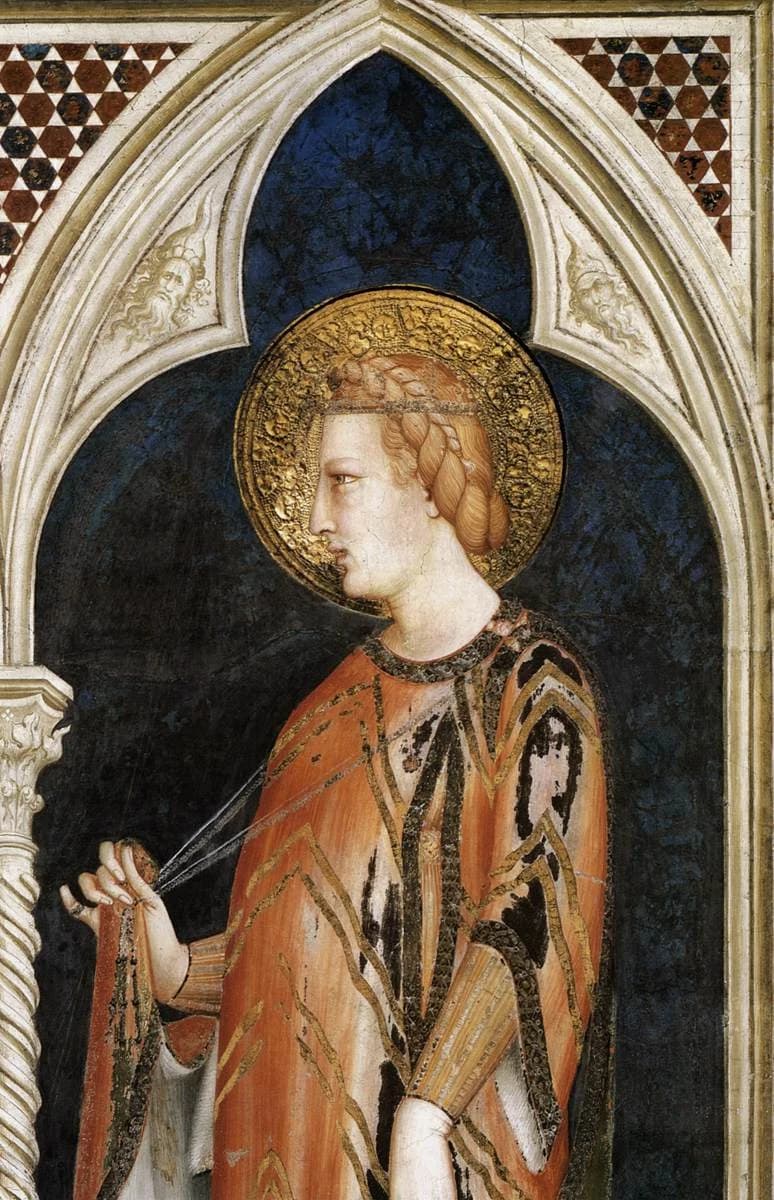
The glittering images at Wartburg tell the life of a woman who died in 1231. Yet their glass mosaics were completed in 1906. Elisabeth’s story begins with that distance: between the medieval woman, the evidence left by others and the figure later generations wanted to remember.
Thuringia and Hesse in the 13th century
Born in Hungary in 1207, Elisabeth was the daughter of King Andreas II and Gertrud of Andechs-Meranien. At about four she was sent to the Thuringian court through a dynastic marriage arrangement. In 1221 she married Landgrave Ludwig IV; they had three children.
Her religious practice developed amid movements seeking evangelical poverty. After Ludwig’s death in 1227, she left court and founded a hospital in Marburg in 1228. Her life cannot be reduced to a charitable princess in a single legend: it also involved family arrangements, resources and the authority of her confessor.
E1E2E3For a four-year-old royal daughter, the journey to Thuringia was an arrangement between families, rather than an adult choice of home. A princely household provided education and status while preparing her for marriage. The castle belongs to this history of family politics as much as to a history of fortifications.
Wartburg is the best-known setting, but the family used other residences too. Creuzburg was an important place in their lives; local heritage accounts record the birth of their son Hermann there in 1222. Elisabeth should not be imagined spending every day of her childhood and marriage in one room at Wartburg.
E1E2E10E11Accounts connect her relief work around the famine of 1226 with material aid and care for the sick. A hospital below Wartburg gives that work a specific setting. Ludwig supported her charitable activity, although aspects of her way of life conflicted with expectations at court.
The famous rose miracle tells of bread becoming roses when her gift was inspected. It is a religious legend, with differing versions, rather than a documented incident. Her work for people in need offers a substantial story without turning a miracle into evidence of what her husband actually said or forbade.
E2E3E11Ludwig died at Otranto on 11 September 1227 while travelling on crusade. He did not die fighting in the Holy Land. Elisabeth, about twenty, faced changes in her family position, resources and religious life.
Accounts differ in emphasis: some describe pressure forcing her to leave Wartburg, others her refusal to accept the life expected of a princely widow. Both point to a conflict with courtly expectations. Subsequent arrangements gave her resources for her new life and hospital; personal simplicity did not mean having no means for charitable work.
E1E2E3E13In Marburg she founded a hospital named for Francis of Assisi in 1228 and took part in nursing. Here the story moves from acts of giving to the work and organisation of care. The hospital, rather than the castle, became the principal setting of her final years.
Her confessor Konrad of Marburg also matters. He helped secure arrangements for her life, demanded strict obedience and later promoted her canonisation. The sources describe a difficult relationship involving spiritual authority and constraint, alongside her own agency. Neither an idealised mentor story nor a retrospective psychological diagnosis does justice to it.
E1E2E3E4Elisabeth died in Marburg on 17 November 1231, aged about twenty-four, and was buried in her hospital chapel. Canonisation followed in 1235. On 1 May 1236 an elevation of her remains drew an assembly including Emperor Friedrich II.
The Teutonic Order became central to the cult around her grave. Work on the Elisabethkirche began in 1235, creating a monumental setting for the memory of a woman associated with poverty and care. These are events in the history of devotion; they do not establish every reported miracle as a historical fact.
E3E12E14Moritz von Schwind painted Wartburg’s Elisabeth Gallery in 1854–1855. The glass mosaics in the Elisabeth Bower belong to a different campaign, completed in 1906. Both are later interpretations of her life.
The foundation describes the bower as very probably a medieval women’s chamber. That does not establish the present interior as her unchanged private bedroom. A visit can reveal two histories at once: the life associated with the castle and the changing ways that life was pictured and commemorated.
E7E8E9CHRONOLOGY
Born into the Hungarian royal family.
Sent to the Thuringian court, aged about four.
Marries Ludwig IV.
Her three children are born.
Ludwig dies at Otranto; she later leaves court.
Founds the Francis hospital in Marburg.
Dies in Marburg.
Canonisation and elevation of her remains.
Later paintings and mosaics reshape her remembrance at Wartburg.
PLACES & CONNECTIONS
Each connection has its own story. Building, finding refuge and facing a siege are very different relationships.
Court life & later remembranceA setting of her princely life, later reimagined through paintings and glass mosaics.
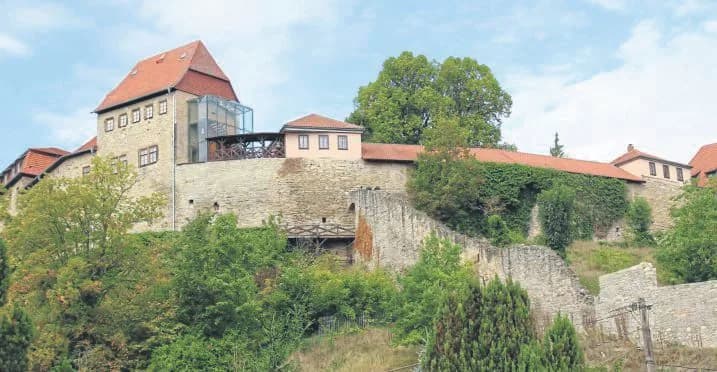 Family residence
Another residence of the landgravial household; local heritage accounts place her son Hermann’s birth here in 1222.
HISTORY & MEMORY
Bread becoming roses belongs to religious legend. Images of the miracle show how Elisabeth was remembered, rather than documenting a witnessed incident.
Konrad’s 1232 Summa vitae was written for canonisation. The testimony of four attendants was shaped into the Libellus in 1235–1236; later biographies stand farther from the events. These are not Elisabeth’s autobiography or unedited interview transcripts.
Sources and modern summaries give differing weight to family pressure and religious choice. The story retains that tension rather than inventing a single dramatic expulsion scene.
17 November 1231 is the death date used here; 19 November is her familiar feast day. She is not the 19th-century Prussian queen Elisabeth or Empress Elisabeth of Austria.
Her direct connection to Marburg concerns the hospital and burial place. This research does not establish the present Landgrafenschloss as her settled residence.
Based on heritage institutions, museums, academic research and historical documents. Sources are attached to the relevant sections.
Editorial review · 27 October 2026
CONTINUE READING
A kingdom imagined in stone
→1483–1546Behind walls, words travelled
→c. 1285–1354Power was built with more than walls
→1795–1861A royal past, a changing world
→1811–1864A kingdom built through culture
→