Before his son’s famous palaces came his own projects: a transformed castle, a university foundation and a vision of Bavaria expressed through buildings and institutions.
Life
1811–1864
Known for
King & patron of education
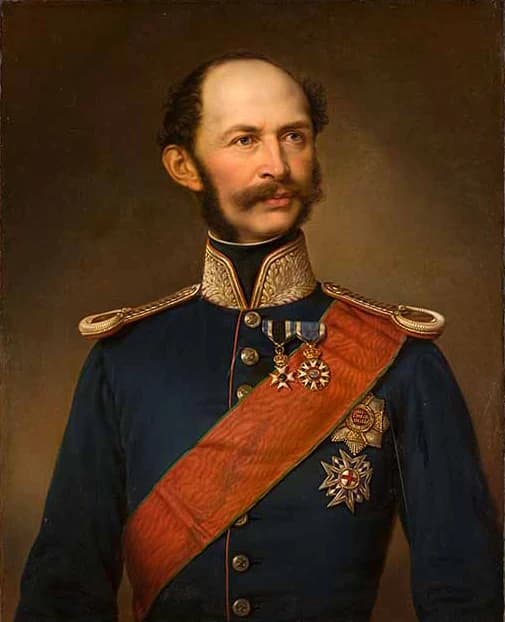
Maximilian II of Bavaria, portrait by Joseph Bernhardt.
Hohenschwangau’s wall paintings surrounded a prince long before he became the builder of Neuschwanstein. The palace was the work of his father, Maximilian II. Following that earlier commission opens a life with ambitions of its own: scholarship, education and a place for Bavaria between larger powers.
Bavaria, 1811–1864
A life in context
Born in Munich on 28 November 1811, Maximilian was the son of Ludwig I and Therese of Saxe-Hildburghausen. He studied in Göttingen and Berlin and developed a lasting interest in history and science. In 1842 he married Marie of Prussia; their sons were Ludwig and Otto.
His father’s abdication made him king on 20 March 1848, amid revolution and demands for reform. He died on 10 March 1864. His cultural and educational work deserves a story of its own, alongside his role in the childhood of Ludwig II.
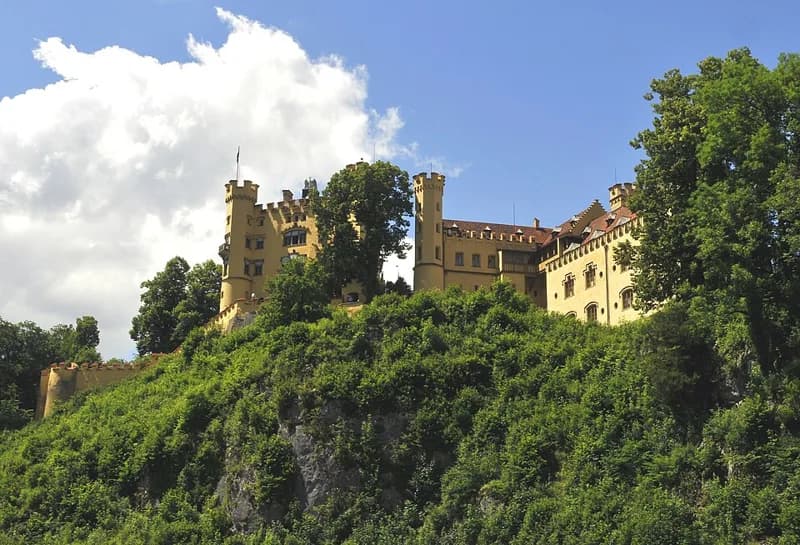
Maximilian first saw the ruins of Schwanstein on a walk in April 1829 and bought them in 1832. Domenico Quaglio and other artists and designers helped transform the site into Hohenschwangau, a royal residence shaped by Gothic Revival taste.
Its paintings brought medieval legend and history into family life. Ludwig later grew up in this setting and developed a separate building nearby. Father and son shared a landscape and a world of stories, but Maximilian did not commission Neuschwanstein: the distinction between the two castles and their patrons matters.
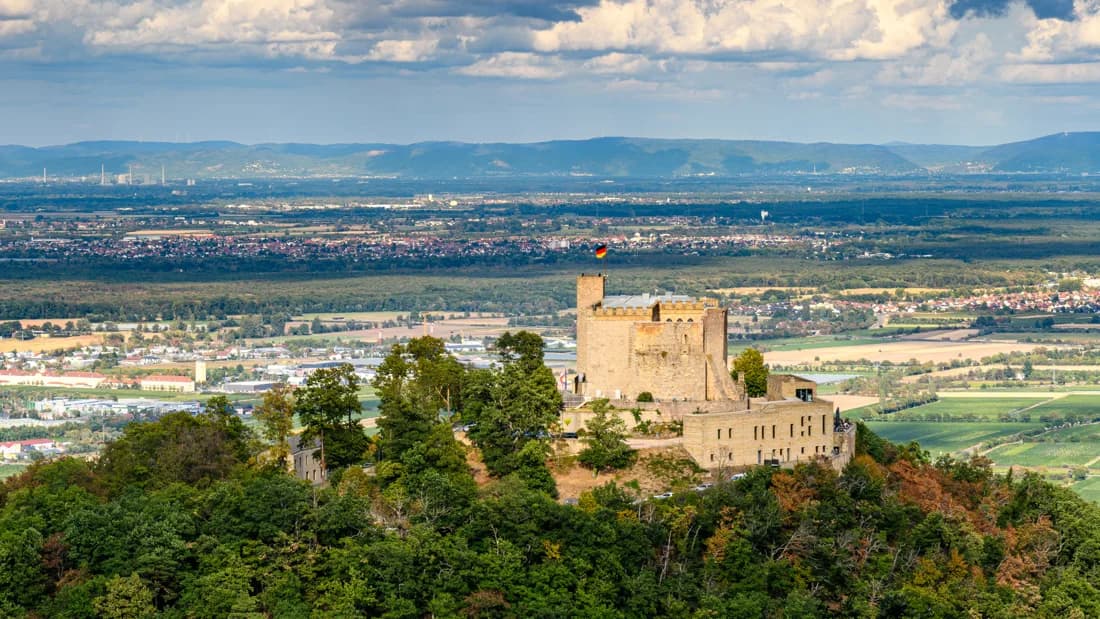
Hambach Castle is remembered for the assembly of 1832 and its demands for freedom and political rights. In 1842 a citizens’ committee acquired the ruin and gave it to Maximilian and Marie as a wedding present. The name Maxburg became associated with it.
Between 1844 and 1846 a summer-residence project based on August von Voit’s plans drew on Hohenschwangau’s Gothic Revival example. Work stopped; this was not a completed palace in regular royal use. One site carried competing memories of civic protest and royal display, without the gift representing unanimous public support for the monarchy.
The new king inherited reform commitments as well as a throne. Changes strengthened the legislature and addressed press freedom, public judicial proceedings and seigneurial jurisdiction. Parliament, ministers, protest and his father’s promises all formed part of the process.
Reform did not mean that he welcomed every limit on his authority. Abroad he sought to preserve Bavaria’s autonomy and a stronger position for the middle-sized German states between Austria and Prussia—the Trias idea. It did not establish a lasting third power equal to those rivals. He died before the wars and settlements of 1866 and 1871.
Scholarship as an institution—and a selective opportunity
In 1852 he founded the Athenäum, renamed Maximilianeum in 1857, to support talented young men and prepare an elite for state service. After parliament declined tax funding, he financed the scheme from royal private funds. Education was also a question of who should decide how resources were used.
The programme widened opportunity beyond family rank and income, but originally excluded women; a separate endowment enabled their admission in 1980. His institutional legacy also includes the Bavarian National Museum, founded in 1855, and the Historical Commission, founded in 1858. The two dates should not be conflated.
A street, a building and a public image of Bavaria
Maximilianstraße connected central Munich towards the Isar and the monumental Maximilianeum on its eastern height. Friedrich Bürklein played a major part in the scheme. The king’s interest in a new architectural language brought historical forms into a contemporary urban project.
The foundation began in 1852, the building in 1857 and completion came in 1874, after Maximilian’s death. The Bavarian parliament moved in in 1949. Its later democratic use belongs to the building’s history, rather than to an original royal plan for the present-day legislature. This was an educational and cultural monument, not the king’s residential castle.
In 1850 Maximilian bought the island of Wörth in Lake Starnberg, later called Roseninsel. Its Casino was built in 1851–1853 as a royal villa, with a garden designed through collaboration including Peter Joseph Lenné. Casino here names a small pleasure residence, not a gambling establishment.
A larger summer-palace scheme in nearby Feldafing remained unfinished when the king died in 1864. Ludwig II later enjoyed the island and received selected guests there, including Richard Wagner. Its fame under the son should not erase the father’s commission or turn the uncompleted mainland palace into a finished building.
Some navigation timelines show 19 March. The specialist biography and palace administration distinguish the decision announced on the 19th from the abdication on the 20th; this account uses 20 March.
Seeing, buying and rebuilding+
1829 marks the first sight of Schwanstein; purchase followed in 1832. Early rebuilding and subsequent alterations span different phases, rather than one immutable completion date.
The unfinished Maxburg+
The current Hambach building history places the works in 1844–1846 and links their end to fading interest. Other summaries vary; the 1848 revolution should not be treated as the sole certain immediate cause of stoppage.
Education and its limits+
Selection irrespective of class did not mean access irrespective of gender, nor universal education. The original foundation also served the aim of training state officials.
A father’s work, a son’s buildings+
Hohenschwangau and Roseninsel have direct commissions by Maximilian. Neuschwanstein is Ludwig II’s project; family influence does not make the father its builder.
Sources & further reading
Based on heritage institutions, museums, academic research and historical documents. Sources are attached to the relevant sections.
 Purchased, rebuilt & inhabited