From a Westphalian water castle to towers above Lake Constance, a writer negotiated family expectations, literary friendships and the possibility of a place of her own.
Life
1797–1848
Known for
Poet, prose writer & composer
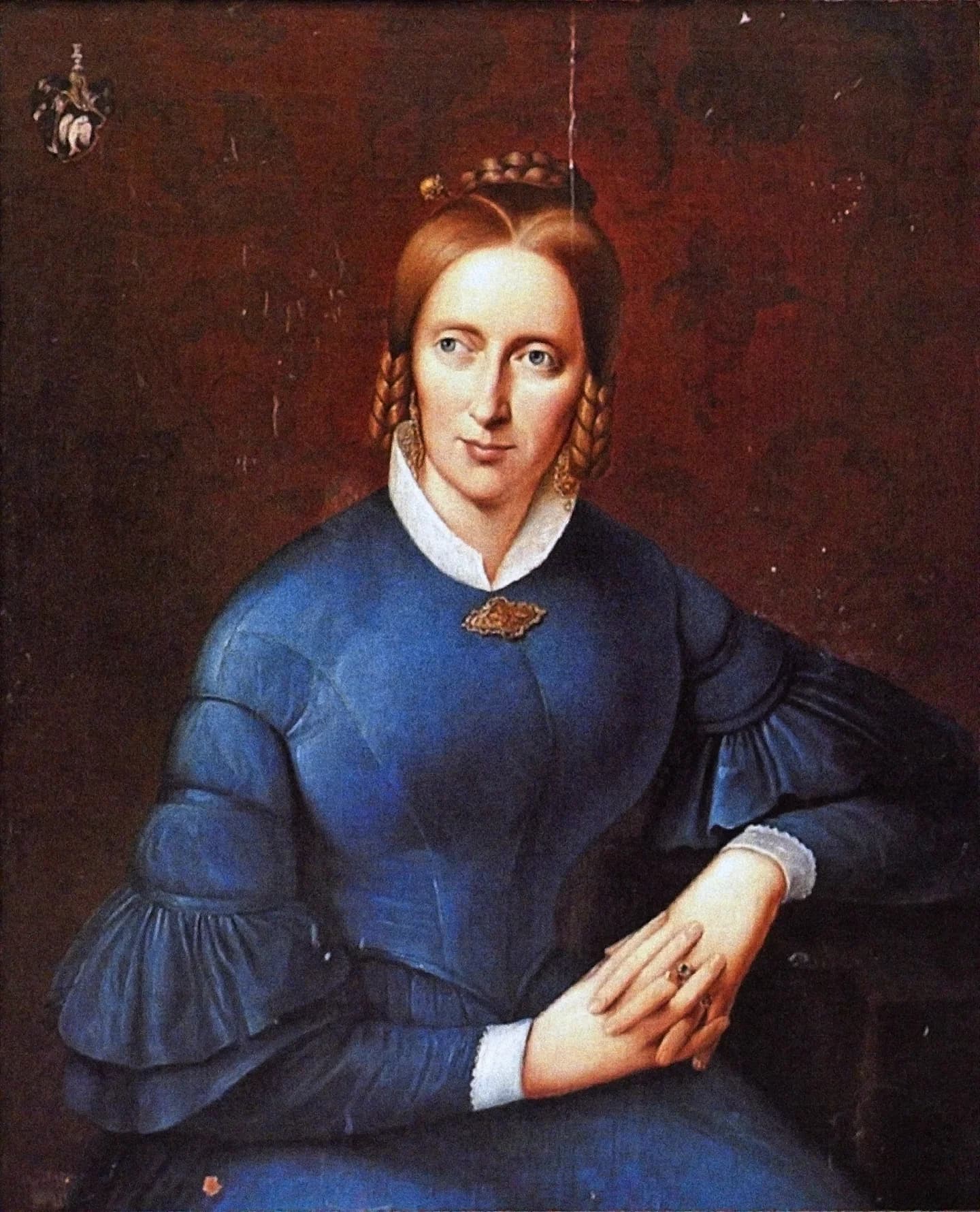
Annette von Droste-Hülshoff, painted by Johann Joseph Sprick in 1838. Historical portrait associated with Burg Hülshoff, reproduced through Wikimedia Commons.
A castle can enter literary history through a room, a view or a family arrangement. Annette’s places reveal the practical conditions of writing: where she could live, who helped a manuscript reach print, and how an anticipated payment could support a purchase.
Westphalia and Lake Constance in the 19th century
A life in context
Born in 1797 at Burg Hülshoff into a Catholic noble family, Annette grew up in Westphalia. Her work includes poetry, prose, music and an extensive correspondence. Die Judenbuche appeared in 1842, while the poetry collection of 1844 gathered many of her best-known poems.
Family resources supported education and cultural contact, while conventions about gender and public authorship constrained her choices. Hülshoff, Haus Rüschhaus and Meersburg served different stages of her life. She died at Burg Meersburg on 24 May 1848.
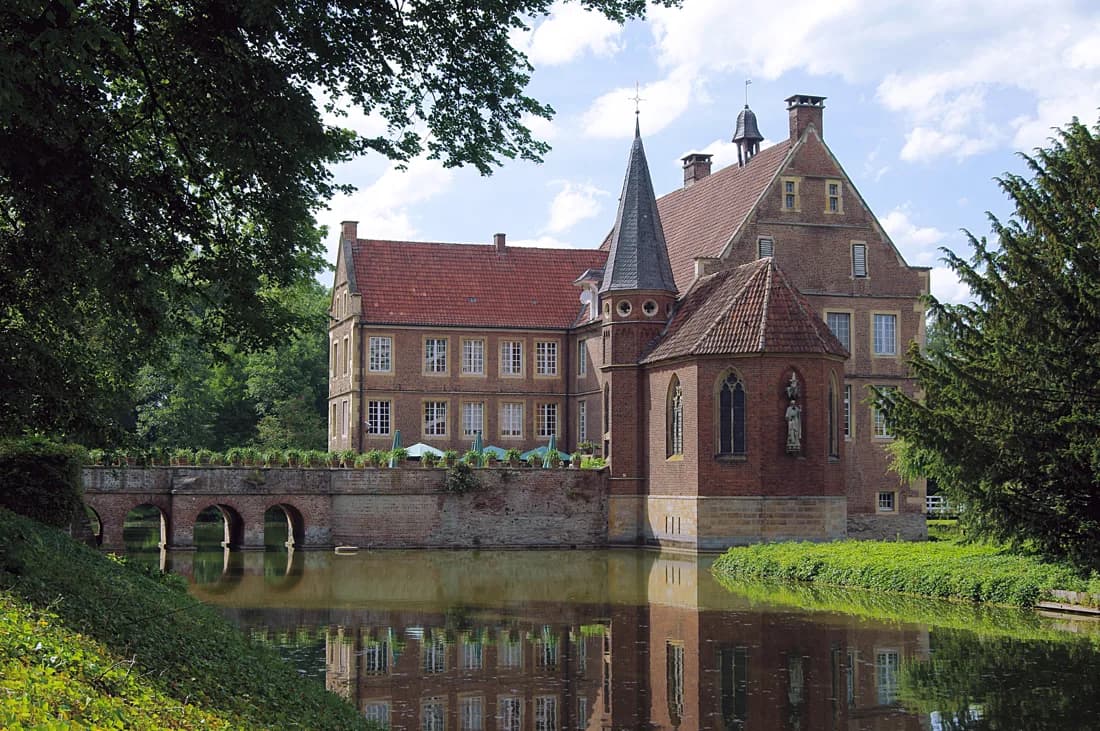
Burg Hülshoff was her birthplace and home until 1826. Its household included visits among related noble families, music, reading aloud, needlework and interest in plants. It offered a social and cultural world, rather than the simple picture of a solitary child enclosed in a medieval building.
Early poems and later experiments with drama, narrative verse and composition show an author developing across forms. The family setting supplied opportunities as well as expectations. A castle can help explain the resources around a future writer without becoming a single cause of her talent or the supposed birthplace of every later work.
After her father’s death in 1826, the ancestral castle passed to her brother. Annette, her mother and her sister moved to nearby Haus Rüschhaus, acquired by her father the previous year. Designed as the architect Johann Conrad Schlaun’s own residence, it combined features of a farmstead and a representative country house.
It became an important long-term writing home; the development of Die Judenbuche belongs to this setting too. Inheritance and the widow’s household shaped the move. Annette retained family resources, but did not independently choose the castle’s succession. Rüschhaus is a country residence, not a separate medieval fortress or a house she bought herself.
Her first collection appeared in Münster in 1838 with only part of her name on the title page. Christoph Bernhard Schlüter helped prepare, arrange and supervise the volume; her mother’s concern about public exposure influenced the presentation. Sales were limited and some family responses were harsh.
Later collaboration with Levin Schücking opened other literary and publishing connections. Elise Rüdiger’s circle and her sister Jenny’s assistance also mattered. For the 1844 collection, Schücking helped secure publication with Cotta, while Jenny copied texts and Annette revised proofs. A contract for 1,200 copies and 875 gulden makes the economic side of literary work visible; it was not simply the moment a male intermediary discovered a hidden talent.
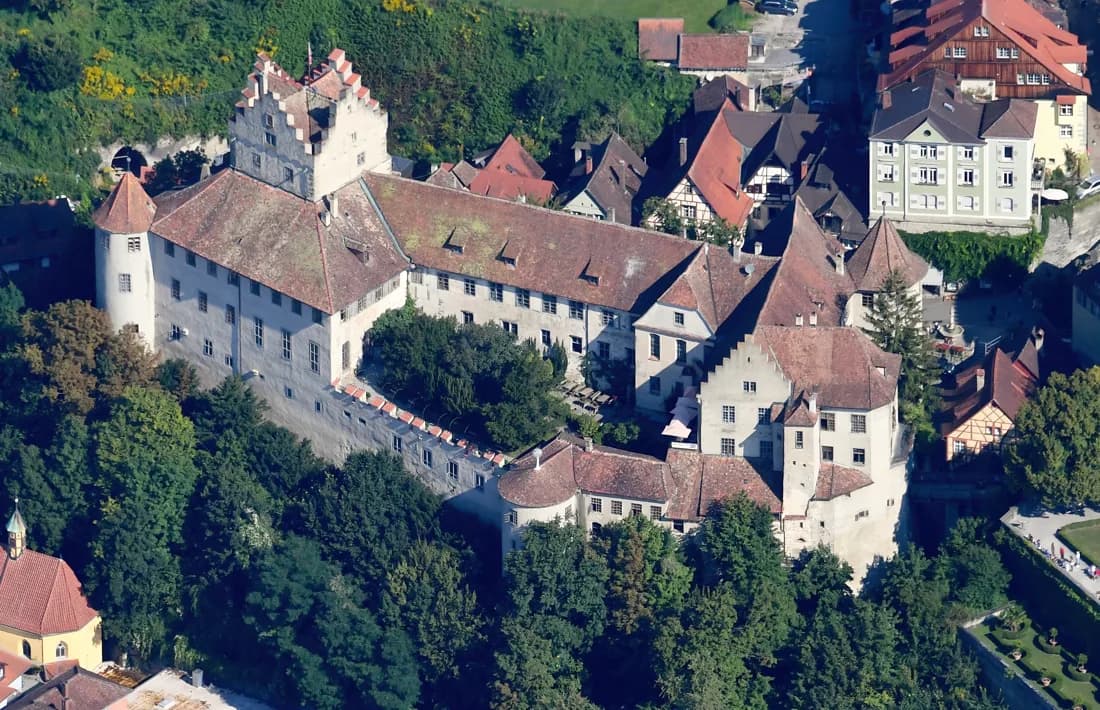
Her brother-in-law Joseph von Laßberg bought Burg Meersburg in 1838. Annette stayed there in 1841–1842, 1843–1844 and 1846–1848. The first stay was in the northeastern tower, the later stays in the southeastern part. Those are separate periods, not seven uninterrupted years in one room.
The winter of 1841–1842 produced about sixty poems, an important core of the 1844 collection. In Am Thurme, storm, waves and a ship accompany a voice longing for action while confronting expectations of feminine restraint. That reading is supported by the poem; its speaker is still a literary voice. Neither every line nor every landscape should be treated as an exact autobiographical view from a particular window.
Die Judenbuche was serialised in the Morgenblatt from 22 April to 28 May 1842. Its Westphalian social world contains crime, rumour and uncertain identity. The publication history is documented, but the fictional characters are not a direct record of Annette’s household or a murder inside a visitor’s castle.
Research by Jochen Grywatsch and Stefan Evers highlights the importance of restricted viewpoints and gaps in what readers can know. The work has invited competing readings rather than one final solution. Poverty, social judgment and anti-Jewish prejudice deserve attention; distinguishing the characters’ speech, the narrator and the author’s historical position requires careful reading. A historical setting should not be sold as a fully solved true-crime case.
In November 1843 Annette bought the Fürstenhäusle, a small former episcopal vineyard house above Meersburg. The purchase drew on anticipated income from the forthcoming poetry volume. It preceded publication in 1844, so the sequence matters: expected earnings supported the decision.
Ownership and residence were different here. Repairs and declining health prevented the house from becoming the settled retreat and writing place she had envisaged. She died at Burg Meersburg instead. The purchase shows a meaningful exercise of choice, but not an instant escape from every constraint; the little vineyard house must not be confused with the castle owned by her sister’s household.
10 January 1797 is widely used. The specialist chronology marks the date as uncertain; older material also gives 12 January. The year and birthplace are secure.
The poem’s speaker and the writer+
Am Thurme can be read in relation to gender and freedom, but its first-person voice is not automatically a literal diary entry. Place of writing and landscape described may differ.
Three stays, two properties+
She stayed at Burg Meersburg in three periods. Her purchase was the separate Fürstenhäusle, not the castle. The small house did not become a long-term residence.
A limited first reception+
Institutional accounts give different small sales totals for the 1838 volume. “Limited sales” is more defensible here than selecting an exact figure without resolving the discrepancy.
Family story and evidence+
The account of a fall on ice causing premature birth is transmitted as a family story, not a verified medical explanation. Literary friendships should likewise not be turned into an undocumented romance.
Sources & further reading
Based on heritage institutions, museums, academic research and historical documents. Sources are attached to the relevant sections.
 Birthplace & formative home