Hunting palaces, porcelain and elaborate court festivals made authority tangible. His story also leads to a contested crown and people whose freedom depended on a ruler.
Life
1670–1733
Known for
Elector of Saxony & King of Poland
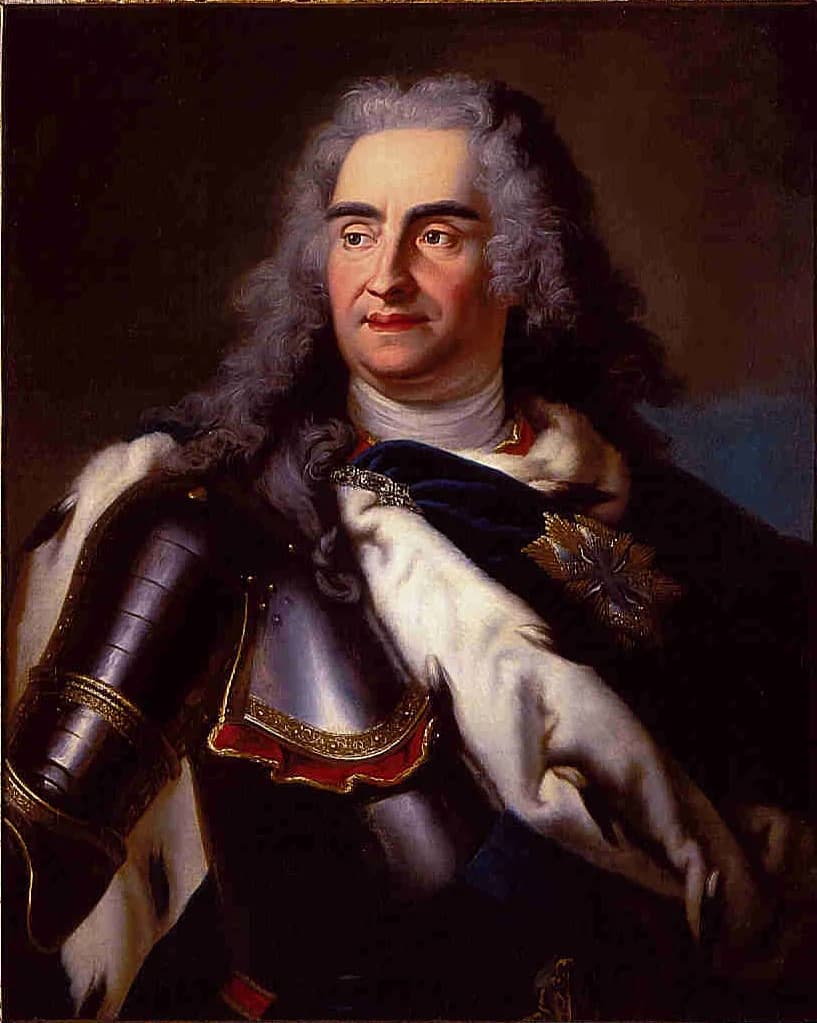
Augustus II the Strong, painted by Louis de Silvestre before 1720. Historical portrait reproduced through Wikimedia Commons.
A hunting trophy, a ceremonial bed and a fortress wine barrel were more than spectacular objects. They belonged to a court that made rank visible. Following them also brings researchers to workshops, administrators and prisoners behind the display.
Saxony and Poland-Lithuania around 1700
A life in context
Born in Dresden on 12 May 1670, he became Elector of Saxony in 1694 as Friedrich August I. In 1697 he converted to Catholicism and obtained the Polish crown as August II. His son later ruled as August III: similar names conceal two different patrons.
The same ruler linked Saxony and Poland-Lithuania without merging their institutions into one state. Architecture and collecting enhanced his royal image, while war burdened his territories and challenged his crown. He died in Warsaw on 1 February 1733.
The younger son was not originally the expected successor. His brother’s death brought him the Saxon electorship in 1694. Conversion in 1697 removed an obstacle to the Polish crown; he was crowned in Kraków on 15 September. Royal status involved election, negotiation and new obligations, not an automatic inheritance.
The change also alarmed Lutheran subjects in Saxony. His religious assurance decree of 29 September promised that they could retain their confession. His own conversion did not order everyone to become Catholic. A ruler’s multiple titles therefore lead into questions about distinct institutions and communities, rather than a single unified Saxon-Polish state.
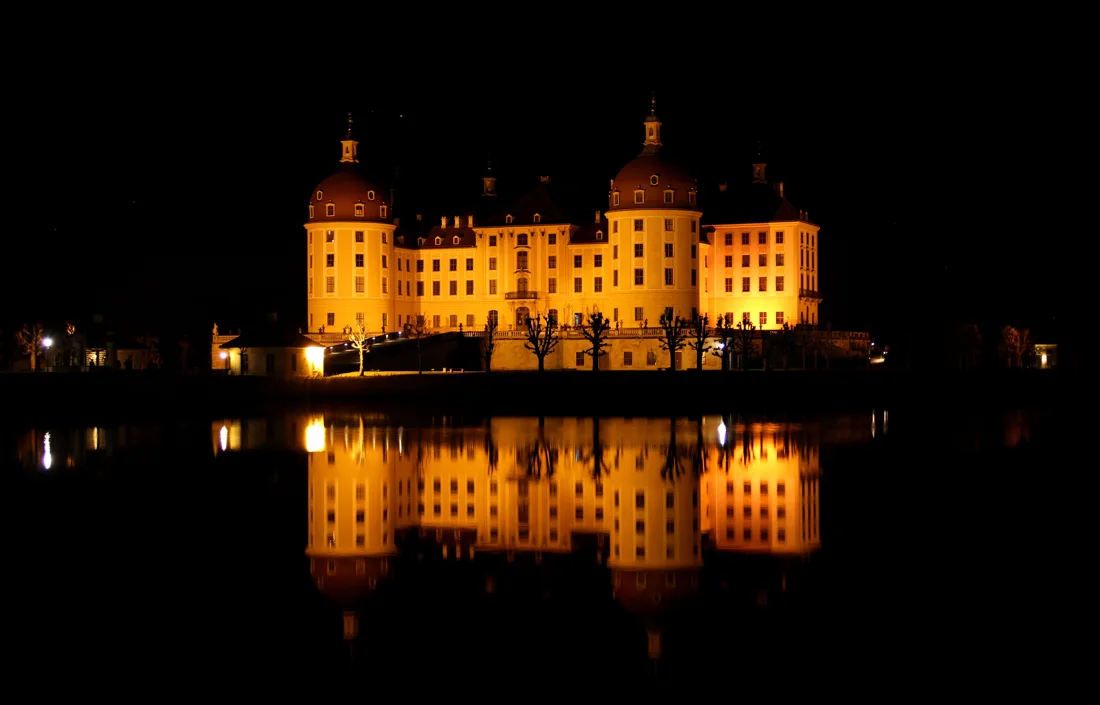
Duke Moritz began the hunting residence in 1542. Augustus’s contribution was the major Baroque transformation begun in 1723 under Matthäus Daniel Pöppelmann. The island palace, interiors and surrounding landscape developed from an older site; Augustus was not its first builder.
Saxon forestry history records trained dogs, attendants and planned forest rides. Hunting required specialised labour, animal management and control of land, as well as ceremony. Trophies can be read within that system rather than only as decoration. The landscape continued to change after his lifetime: later features, including the Fasanenschlösschen, should not all be attributed to him.
Johann Friedrich Böttger’s claims to make gold made him valuable to rulers seeking to control such knowledge. Königstein’s chronology records three months of imprisonment in 1702 and another confinement on Augustus’s orders in 1706. This was a relationship of custody and control, not simply a freely chosen research retreat.
The European hard-paste porcelain breakthrough around 1708 involved Böttger, Ehrenfried Walther von Tschirnhaus, Gottfried Pabst von Ohain and other specialists. In 1710 a manufactory was established at Albrechtsburg in Meissen. Research, confinement and industrial production had different settings. East Asian porcelain long preceded this European development, and scholarship continues to examine each collaborator’s contribution.
The wedding of 1719 was his son’s: Friedrich August married Maria Josepha of Austria in Vienna on 20 August. Dresden’s celebrations followed from 2 to 30 September. State archive records show programmes of processions, riding and hunting games, opera, banquets and fireworks, revealing the organisation beneath the spectacle.
The Dresden palace’s parade apartments were renewed for the occasion. Their ceremonial bedroom and bed served representation; museum interpretation explicitly distinguishes them from the king’s actual sleeping place. A seemingly private room could be made for an audience. Today the restored and reconstructed apartments also require explanation as a historical presentation, rather than untouched furnishings surviving since 1719.
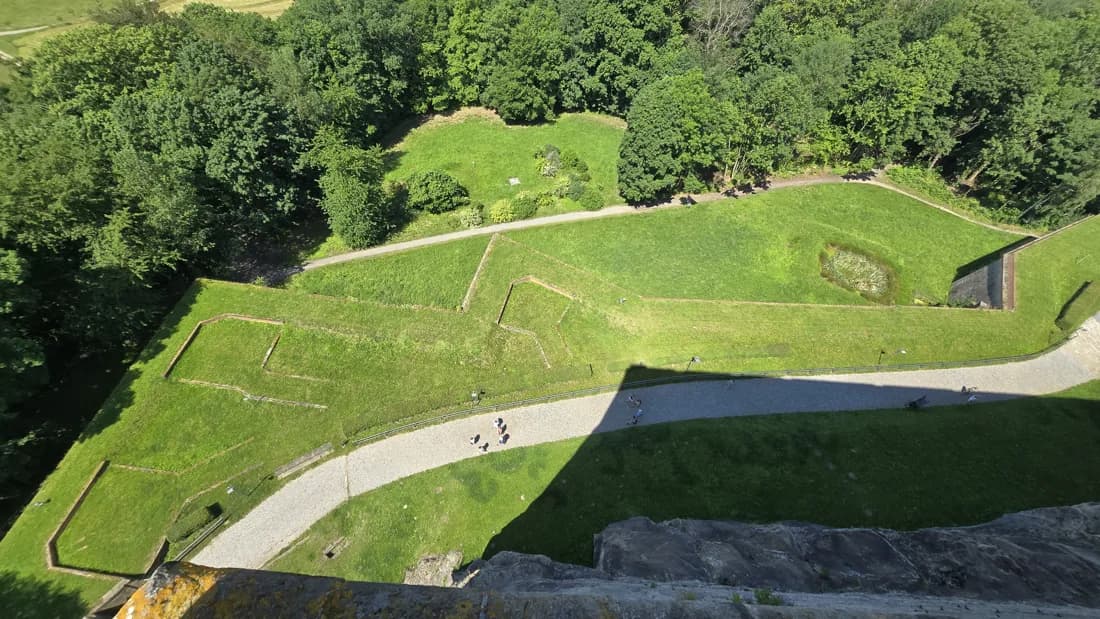
Anna Constantia von Cosel held property and influence at court. Her downfall involved political conflict, a marriage promise and a departure from court, not only a change in the king’s affections. She was held at Burg Stolpen from 1716 until her death in 1765, long after Augustus himself died.
Her imprisonment is often described as forty-nine years. It should not become an invented scene of identical conditions in a dark dungeon throughout that time. Official accounts even differ by a day over her December arrival. Stolpen’s relationship to Augustus concerns the order to confine her; it does not establish that he lived there. Pillnitz, connected with property and later rebuilding, belongs to a different part of the story.
Stories of extraordinary strength and hundreds of children helped form the familiar royal image. The figure of 365 children has no reliable basis. Political power was less secure than the legend suggests: a rival Polish king appeared in 1704, the 1706 peace forced Augustus to relinquish the crown, and he returned to the struggle for rule in 1709.
A more tangible display was the giant wine barrel completed at Königstein in 1725 at his request. The original disappeared; today’s installation is a modern reconstruction. In January 1728 the fortress also hosted Friedrich Wilhelm I and his son, the future Frederick the Great. The visit connects two lives, but does not supply an invented conversation between them. Augustus’s death came in Warsaw in 1733; his body was buried in Kraków, his heart in Dresden.
Friedrich August I of Saxony and August II of Poland are the same man. His son, Friedrich August II of Saxony and August III of Poland, is a different ruler.
European porcelain, not the world’s first porcelain+
East Asian production was much older. The European breakthrough and the later factory should be credited to collaborative technical work, not the king as a lone inventor.
Dates of a disputed kingship+
A rival emerged in 1704; the 1706 peace required renunciation, followed by return in 1709. These mark different events rather than an uninterrupted, uncontested reign.
Cosel’s arrival+
Institutional sources give either 24 or 25 December 1716. The month and year are used here rather than an unverified exact day.
Court spectacle and surviving objects+
The Königstein barrel is a modern reconstruction. Dresden’s parade rooms are a reconstructed historical presentation. A ceremonial bed should not be described as the king’s ordinary bed.
Sources & further reading
Based on heritage institutions, museums, academic research and historical documents. Sources are attached to the relevant sections.
 Baroque rebuilding & court hunting