A flute, a family celebration and a grave on a vineyard terrace open different views of the Prussian king. The buildings also lead to war, unequal rights and the making of his reputation.
Life
1712–1786
Known for
King of Prussia & architectural patron
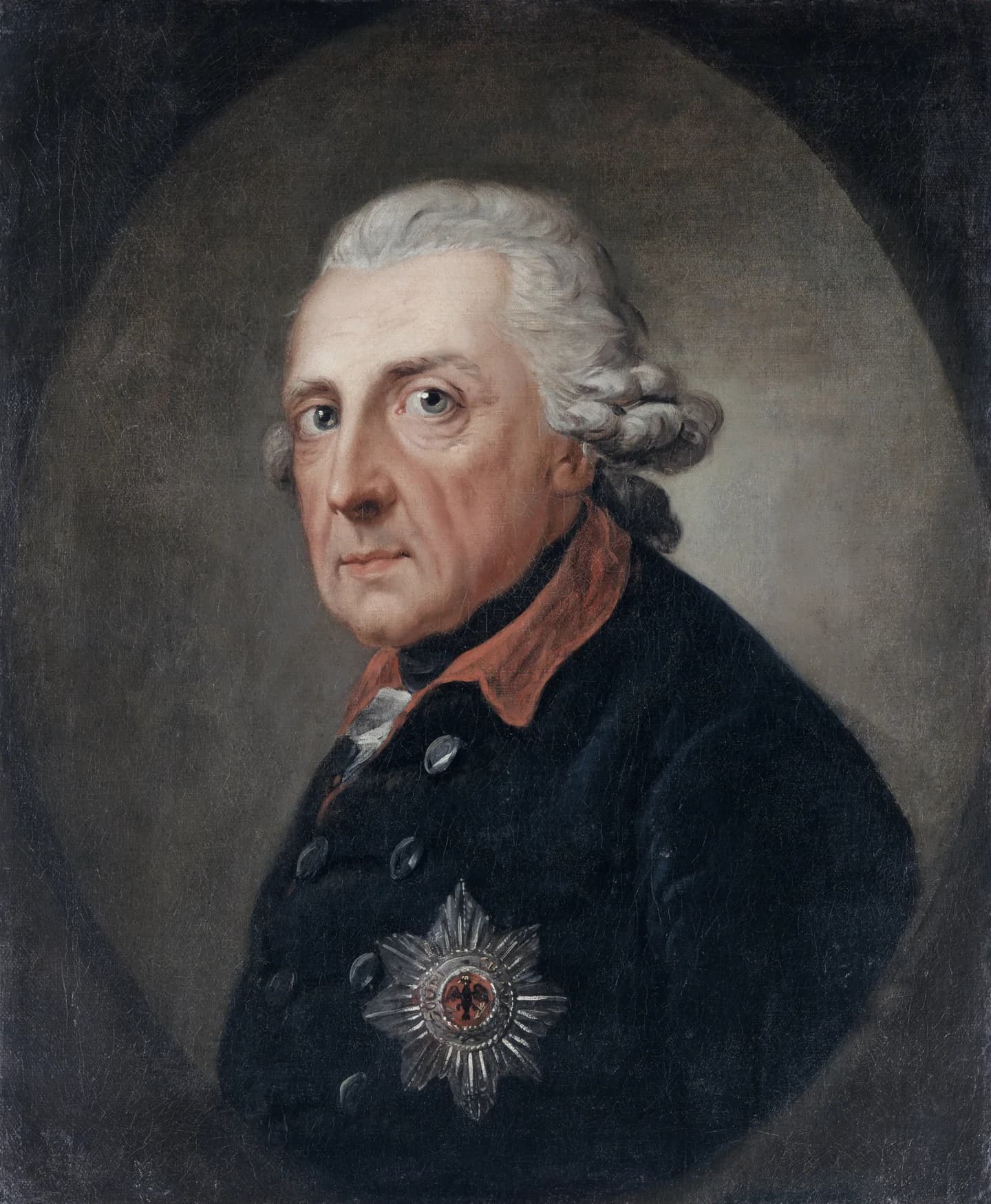
Frederick II of Prussia, painted by Anton Graff between 1781 and 1786. A historical portrait reproduced through Wikimedia Commons.
Visitors still leave potatoes on the king’s grave at Sanssouci. The gesture is real; the familiar claim that he introduced the potato into Prussia is another matter. His life is best approached through that distinction between evidence, surviving places and the stories repeated about them.
Prussia in the 18th century
A life in context
Born in Berlin on 24 January 1712, Friedrich was the son of Friedrich Wilhelm I and Sophie Dorothea. He married Elisabeth Christine in 1733 and succeeded his father in 1740. The marriage remained childless; his nephew Friedrich Wilhelm II later inherited the throne.
Music, French-language intellectual life and military expansion all belonged to his reign. He died at Sanssouci on 17 August 1786. The title “the Great” records a historical reputation; judging his policies also requires attention to the people who bore their costs.
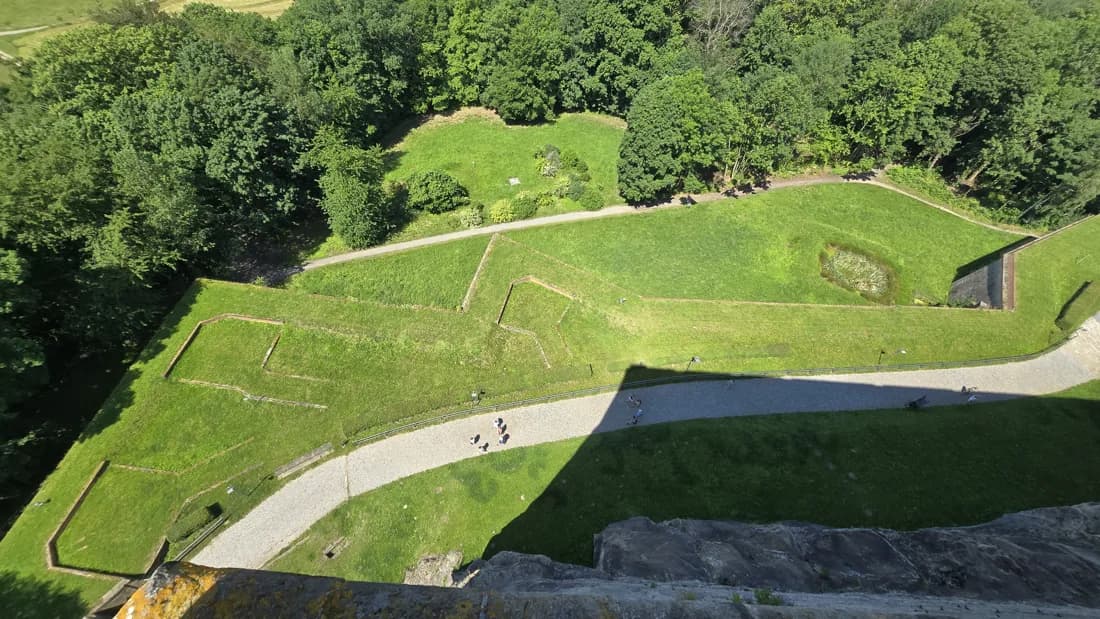
In 1730 the crown prince’s attempt to escape his father’s authority became a state affair. Hans Hermann von Katte, who had been involved in the plan, was sentenced by a military court to lifelong imprisonment. Friedrich Wilhelm I overruled that judgment and ordered his execution on 6 November at Küstrin, today Kostrzyn nad Odrą in Poland.
The prince was ordered to witness it. The event exposes the overlap of family discipline, military obedience and sovereign power. Details of what he could actually see remain uncertain, and later dialogue should not be treated as a transcript. Küstrin was the setting; the execution must not be relocated to Sanssouci.
Between 1736 and 1740, Rheinsberg gave the artistically ambitious crown prince a residence to shape. He enlarged the Renaissance castle into a three-wing complex and developed garden axes later echoed at Sanssouci. Building and landscape offered ways of arranging a cultural household before he became king.
In 1744 he gave Rheinsberg to his brother Heinrich, whose long stewardship added substantial garden and theatrical features. The place visitors encounter therefore belongs to more than one patron. Calling it a formative residence is well supported; assigning every surviving feature to Friedrich is not.
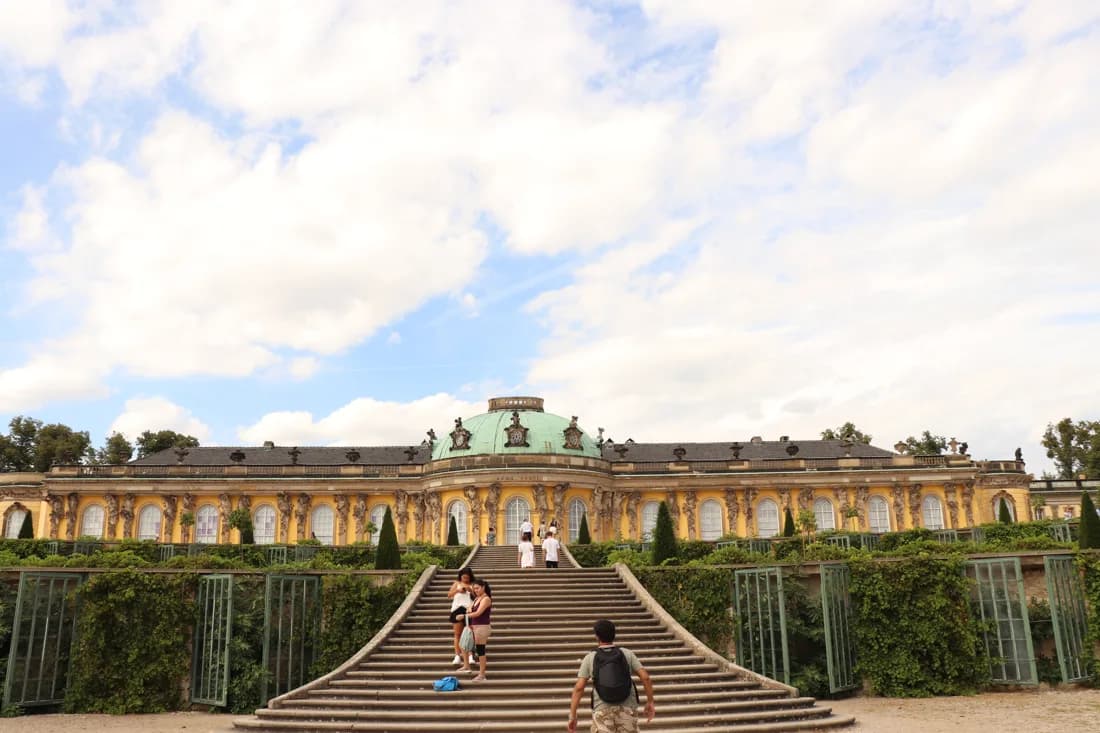
Sanssouci was completed in 1747 after about two years of building. Georg Wenzeslaus von Knobelsdorff developed plans from the king’s ideas for a retreat above the vineyard terraces. Music and intellectual conversation formed part of this environment. Voltaire belonged to the court between 1750 and 1753, but their relationship included serious conflict.
Johann Sebastian Bach’s royal reception in 1747 took place at the Potsdam City Palace, not Sanssouci. Adolph Menzel’s famous Flute Concert at Sanssouci was painted in 1850–1852, long after the king’s death. It evokes an earlier musical world while also showing how the nineteenth century pictured Prussia; it cannot verify every person or gesture in a single evening.
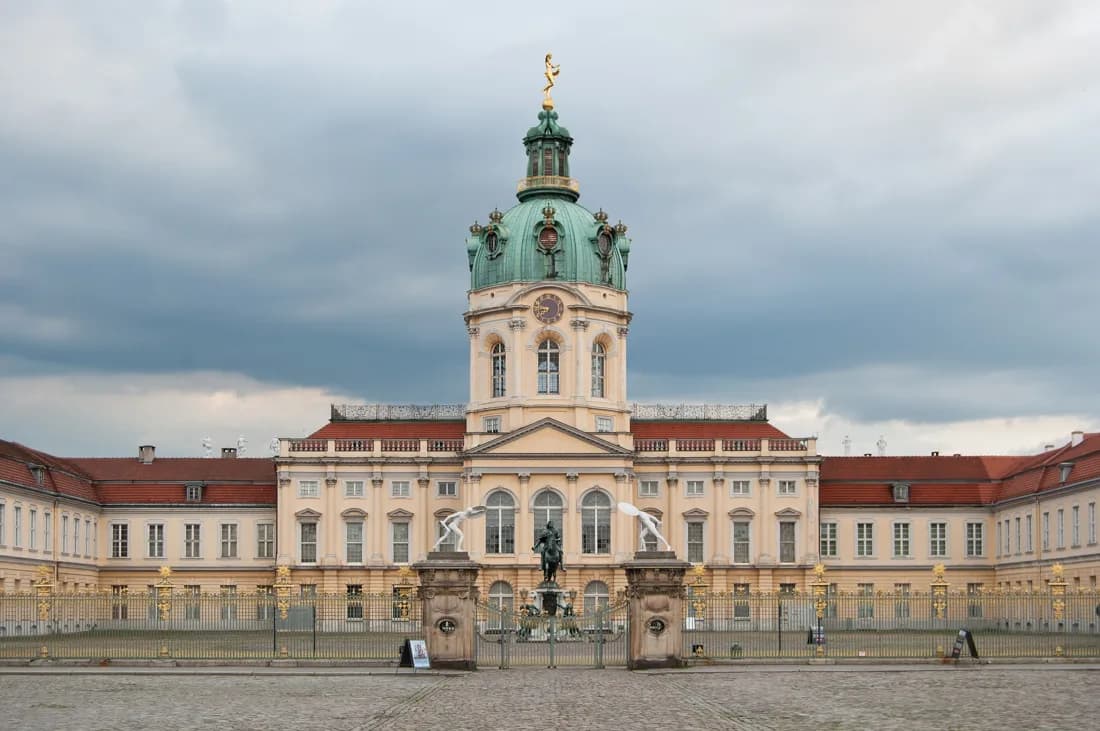
Only two months after his accession, Friedrich laid the foundation stone for Charlottenburg’s New Wing. Apartments and festival rooms served the royal household, including weddings of siblings, nieces and nephews. These uses complicate the image of a king entirely detached from family ceremony.
The New Palace at Potsdam expressed another purpose after the Seven Years’ War: representation through galleries, festival halls, guest apartments and a theatre. The king also occupied his own suite during summer visits by family and rulers. Charlottenburg, Sanssouci and the New Palace reveal different court functions. Reconstructed rooms and later furnishings must still be distinguished from untouched eighteenth-century interiors.
Friedrich’s intellectual reputation and the Anti-Machiavel encouraged hopes at his accession. Yet in 1740 he invaded Silesia, and in 1756 he invaded Saxony. The Seven Years’ War ended in 1763 after enormous military losses, civilian suffering and devastation. Palatial splendour cannot by itself describe the condition of the people who supplied the resources.
Religious toleration also stopped short of equal rights. The 1750 regulations presented by the Jewish Museum Berlin show restrictions on Jewish residence, occupations, marriage and family continuity. Artistic openness, state expansion and legal inequality coexisted. Reading them together gives a fuller account than celebrating a modern democratic ideal in an eighteenth-century monarchy.
Friedrich wanted burial on the upper terrace of Sanssouci, but that wish was fulfilled only in 1991. Today potatoes left on the grave connect the palace to a popular image of the king as a benefactor. The custom is evidence of remembrance; it does not establish how an agricultural policy worked.
SPSG historian Jürgen Luh challenges the claim that Friedrich introduced the potato into Germany or Prussia. Orders encouraging cultivation existed, but introduction, implementation and results are separate questions. The familiar tale of guards deliberately allowing villagers to steal potatoes is not established by the evidence used here. The surviving place is an invitation to examine how a useful story became a royal legend.
The portrait above is a historic artwork. Menzel’s later concert painting belongs to a different period and provides evidence of nineteenth-century historical imagination.
Two similarly named fortresses+
Küstrin concerns the failed escape and Katte’s execution. Königstein concerns a documented 1728 royal visit. They are different places with different relationships.
A king’s name and a later king+
Friedrich II and Friedrich Wilhelm IV were different rulers. Sanssouci’s original commission belongs to the former, its nineteenth-century side-wing alterations to the latter.
Enlightenment and unequal rights+
Religious toleration should not be equated with modern civil equality. Jewish regulations and wars remain part of the reign.
Memory and agricultural history+
Potatoes at the grave are a living custom. They do not prove the king introduced the crop or that all cultivation orders succeeded.
Sources & further reading
Based on heritage institutions, museums, academic research and historical documents. Sources are attached to the relevant sections.
 Commission, summer residence & burial