A Prussian princess shaped court culture through opera, rooms and literary landscapes. Her connection with Zwernitz belongs to the garden around the medieval castle.
Life
1709–1758
Known for
Margravine, composer & cultural patron
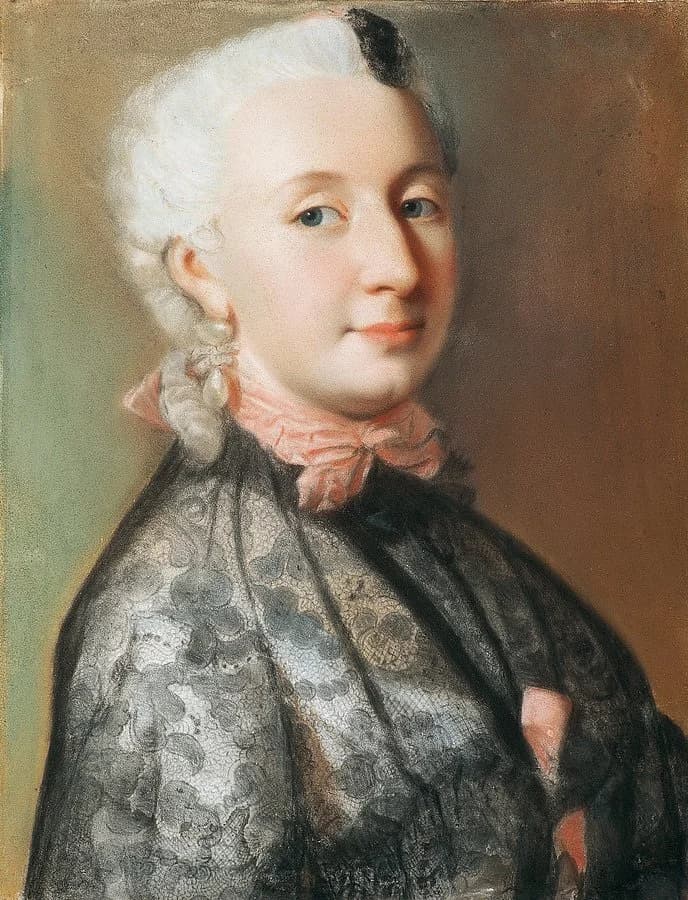
Wilhelmine of Bayreuth, portrayed by Jean-Étienne Liotard around 1745. Historical artwork held at the Neues Schloss Bayreuth, reproduced through Wikimedia Commons.
At Sanspareil, rocks and caves became settings for a literary journey. In Bayreuth, rooms and a theatre gave music and imagination a physical form. Wilhelmine’s story asks how a royal woman could shape these places, and whose work made that possible.
Bayreuth in the 18th century
A life in context
Born in Berlin on 3 July 1709, Wilhelmine was the daughter of Friedrich Wilhelm I and Sophie Dorothea, and the elder sister of Frederick the Great. She married Friedrich of Brandenburg-Bayreuth in 1731, arrived in Bayreuth in 1732 and became margravine when her husband succeeded in 1735. She died there on 14 October 1758.
She composed, wrote, performed and participated in the conception of interiors and gardens. Cultural patronage gave her practical influence, but commissioning, suggesting a scheme and carrying out professional construction remained different roles. Architects, craftspeople, musicians and the wider court belong in the account.
For years her mother pursued an English royal marriage, alongside plans for Wilhelmine’s brother. The project failed amid changing dynastic interests and alliances. In 1731 Wilhelmine instead married the heir to Bayreuth and reached the Franconian court in January 1732.
Her memoirs later made the contrast with Berlin dramatic. Christina Strunck’s 2024 biography emphasises the subjective, literary shaping of that account. Her disappointment is evidence of how she presented the move, not an objective verdict on every aspect of local culture. From 1735 the couple increasingly reshaped the residence and its cultural life.
On 3 July 1735 her husband gave her the Eremitage. Georg Wilhelm had already established its Old Palace in 1715, and the court had staged a hermit’s life there with robes, tiny cells and simple utensils. Wilhelmine received and transformed an existing courtly place, rather than founding it from nothing.
The women’s wing brought together music, reading and domestic rooms. Later, the Eremitage’s New Palace arranged a Sun Temple and curved wings with plant-wintering and aviary functions. The palace administration reads the ensemble through Apollo and the elements. Such symbolism is a documented interpretation, not a surviving personal design manifesto for every detail.
The Old Town Palace burned on 26 January 1753, prompting a new city residence. Joseph Saint-Pierre was responsible for its architectural construction, incorporating earlier buildings into the elongated Neues Schloss Bayreuth. Wilhelmine participated actively in planning and interiors; a letter about drawing her palace plan does not make her the sole professional architect.
Her cabinet used irregular mirror fragments on the ceiling, unlike the mirrored walls of a related room at the Eremitage. The city’s New Palace and the Eremitage’s New Palace are different buildings. Nor should the Italian Palace added for Friedrich’s second wife from 1759 be credited wholly to Wilhelmine, who had died in 1758.
By the late 1730s Wilhelmine was directing court music, and Argenore is an established opera by her from 1740. The new opera house came later: it opened for the 1748 celebrations of her daughter Elisabeth Friederike Sophie’s marriage to Carl Eugen of Württemberg. Giuseppe and Carlo Galli Bibiena shaped the theatre interior; Saint-Pierre’s stone façade followed in 1750.
A timber auditorium assembled inside a masonry shell, with paint and canvas creating illusion, made spectacle a matter of craft and construction as well as performance. Argenore’s 1740 premiere cannot be relocated into this later theatre. The wedding operas Ezio and Artaserse likewise should not be assigned wholly to her as composer merely because she helped organise court culture.
Between 1744 and 1748, the court developed the rocky woodland near Zwernitz with buildings, scenic features and a ruin theatre. Wilhelmine interpreted caves and rocks through the adventures of Telemachus. Names such as Calypso’s and Mentor’s grotto preserve that literary programme, while many built features have since disappeared.
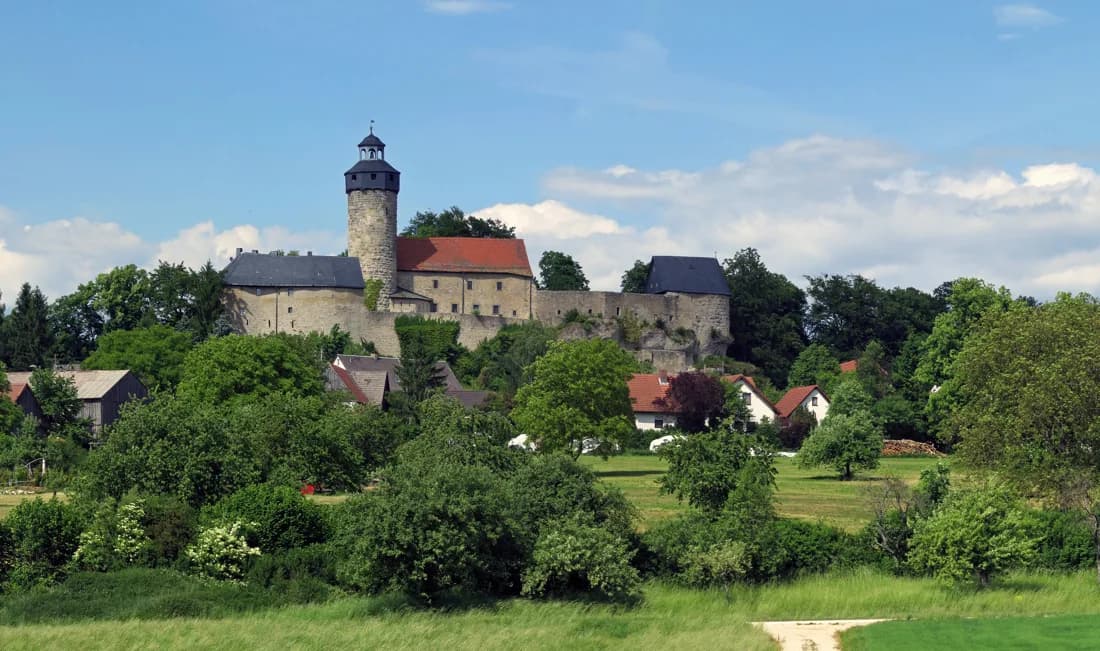
Zwernitz itself was already documented in 1156. Its official history attributes repairs in the 1740s to her husband Friedrich, who made it a historical view within the garden landscape. Wilhelmine’s connection is therefore through the Sanspareil project and its literary conception, not original castle construction or proven residence in the keep. The exclamation said to explain the name Sanspareil remains a naming tale.
Wilhelmine’s memoirs preserve an influential voice, but also a problem of dating. The palace timeline lists composition in 1744–1747; Strunck’s newer scholarly biography argues from internal evidence for an unfinished manuscript left around 1744, narrating events only through 1742. A memoir is a crafted retrospective, not a transcript of childhood dialogue.
After her death in 1758, family history continued at places associated with “Wilhelmine’s Bayreuth”. Fantaisie is an important distinction: the surviving new palace was begun by her husband in 1761 and developed by their daughter after 1763. It was not Wilhelmine’s completed later home. Catalogues of letters, books and artworks offer further research routes without proving every familiar attribution.
Rainer Lippert
→ Derivative work: Steffen Schmitz (Carschten) · Wikimedia Commons · CC0 · Resized, converted to WebP and cropped for display
HISTORY & MEMORY
History, memory & uncertainty
Two New Palaces+
Neues Schloss Bayreuth is the city residence. Neues Schloss Eremitage is a different garden ensemble; their functions and construction histories should remain distinct.
Zwernitz and the garden+
The castle predates her by centuries. Her connection runs through Sanspareil; the documented castle repairs were ordered by Friedrich.
Music attribution can change+
Strunck’s 2024 biography identifies the G-minor harpsichord concerto often assigned to her as a work by Johann Gotthilf Jänichen. An old recording credit is not conclusive authorship evidence.
Mother and daughter+
Elisabeth Friederike Sophie lived from 1732 to 1780 and developed Fantaisie after her parents’ deaths. Her residence should not be transferred to her mother.
Memoirs and cultural imagination+
Memoirs have a viewpoint and disputed composition dates. Chinoiserie and Japanese room names also describe European courtly imaginings, not reliable accounts of East Asian daily life.
Sources & further reading
Based on heritage institutions, museums, academic research and historical documents. Sources are attached to the relevant sections.
 Sanspareil garden & literary landscape